Imitation Learning from Human Motion Alone Does Not Guarantee Biomechanically Plausible Gait Kinetics

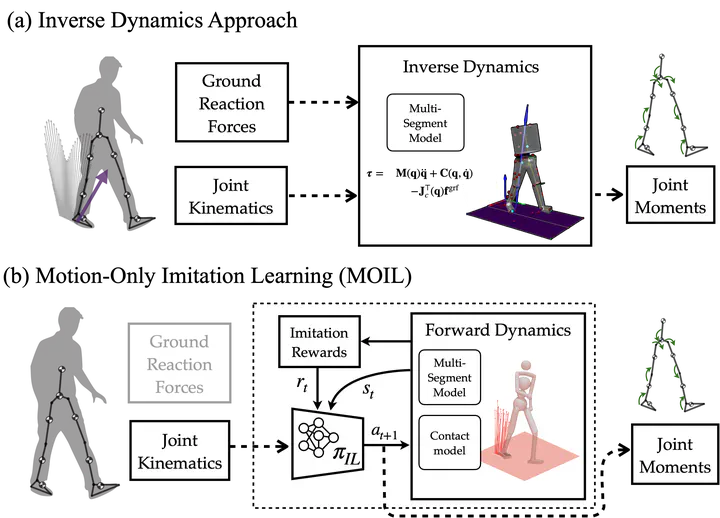 Comparison of (a) a biomechanics inverse dynamics pipeline and (b) a motion-only imitation learnin(IL) pipeline integrating a reinforcement learning agent with forward dynamics
Abstract
With the growing interest in motion imitation learning (IL) for human biomechanics and wearable robotics, this study investigates how additional foot-ground interaction measures, used as reward terms, affect human gait kinematics and kinetics estimation within a reinforcement learning-based IL framework. Results indicate that accurate reproduction of forward kinematics alone does not ensure biomechanically plausible joint kinetics. Adding foot-ground contacts and contact forces to the IL reward terms enables the prediction of joint moments in forward walking simulation, which are significantly closer to those computed by inverse dynamics. arxiv
Type
Publication
arXiv preprint arXiv:2603.12408 (submitted to IEEE RA-L)
Mathematical Formulation
Imitation Learning Objective
The policy maximizes expected cumulative reward:
$$ J(\theta) = \mathbb{E}_{\pi_\theta} \left[ \sum_{t=0}^T \gamma^t r(s_t, a_t, q^{\exp}_t, f^{\exp}_{\mathrm{grf},t}, x^{\exp}_{\mathrm{cop},t}) \right] $$Where $ r(\cdot) $ includes kinematics $ R_k $ and dynamics $ R_{\mathrm{dyn}} $ terms.
Reward Components
Kinematics reward:
$$ R_k = w_p R_p + w_{ee} R_{ee} + w_{rp} R_{rp} + w_{rv} R_{rv} + w_{vf} R_{vf} $$Dynamics reward:
$$ R_{\mathrm{dyn}} = w_{\mathrm{grf}} R_{\mathrm{grf}} + w_{\mathrm{cop}} R_{\mathrm{cop}} $$With GRF term $ R_{\mathrm{grf}} = \exp\left( -k_{\mathrm{grf}} \|\Delta f_{\mathrm{grf}}\|^2 \right) $ and CoP term $ R_{\mathrm{cop}} = \exp\left( -k_{\mathrm{cop}} \|\Delta x_{\mathrm{cop}}\|^2 \right) $.
Technical Approach
Key Components
- RL-based IL with PPO and residual force control in MuJoCo.
- Ablation on kinetics rewards: baseline (kinematics-only, MOIL), +GRF, +CoP, full KAIL.
- Forward dynamics simulation of musculoskeletal model matching Visual3D inverse dynamics.
Performance Metrics
- Joint angle RMSE <7° across conditions.
- GRF correlation improves significantly with kinetics rewards (p<0.001).
- Joint moment RMSE reduced, correlations increased (p<0.0001) in KAIL vs. MOIL. The figure shows simulated human gait skeletons adapting walking speeds via imitation learning, illustrating kinematic fidelity in MuJoCo environments similar to the study’s setup.
Research Significance
Motion imitation alone prioritizes kinematic matching but yields implausible GRFs and joint moments due to unphysiological foot-ground interactions. KAIL with GRF/CoP rewards ensures biomechanical plausibility, critical for biomechanics analysis, clinical diagnostics, and wearable robot design.
Implementation Highlights
- Data from motion capture and force-plate treadmill on healthy subject walking at 1.2 m/s.
- MuJoCo model with floating-base, impedance control, trained 900 PPO iterations.
- Evaluation via GRF butterfly diagrams, CPCC, joint moment RMSE/correlations vs. inverse dynamics.